Showing posts with label The Old Buzzard's Roost. Show all posts

Monday, April 25, 2011

Smoke Plants of North America

"What a rabbit eats we can smoke"


Smoke Plants of North America by Author Mairi R. Ross. Ms. Ross acknowledges the serious negative health, social, and spiritual consequences of smoking commercial cigarettes and the author challenges us to look past our modern practices and rediscover the truth about the age old ritual of smoking.

The author shares her personal discovery of over 150 wild plants, legal, non-addictive, medicinal, and enjoyable, that have been smoked by Native Americans and others for centuries. Compiled here for the first time in print, this knowledge is drawn from the author's own experience and her research into original ethnobotanical texts and contemporary herbalism. Acknowledging the serious negative health, social, and spiritual consequences of smoking commercial cigarettes, the author challenges us to look past our modern practices and rediscover the truth about the age old ritual of smoking. In this book you will discover: over a dozen smoke mix recipes made with legal, non addictive herbs that calm nerves, reduce anxiety, relieve insomnia and may help you stop or reduce cigarette and marijuana smoking. A guide to gathering over 50 smokeable wild plants. Over 150 smoke plants, many traditionally used by the Navajo, Iroquois, Cherokee, Hope, Cowasuck and other Native Americans. The original spiritual purpose of smoking. 5+"x 7+", 182 page paperback. Available from www.Back40Books.com for $15.95 + shipping

Wednesday, August 18, 2010

Whispers of the Ancients: Native Tales for Teaching and Healing in Our Time


I am pleased to recommend a new book by Tamarack Song, illustrations by Moses (Amik) Beaver. It's easy to imagine yourself transported back to a time when an Elder might have told stories like those in Whispers of the Ancients around a glowing hearth. Thanks to Tamarack Song's storytelling skills, monsters, heroes, and shapeshifters come alive and open a doorway to the mysteries of life.

Stunning Aboriginal artwork by Moses (Amik) Beaver combines with provocative storytelling to renew, in all their traditional splendor, exceptional legends from around the world. Entertaining, profound, passionate, glorious these are stories that illustrate and evoke themes common to everyone's life, with an ancient wisdom that helps the listener to cope with today's opportunities for tenderness, grief, passion, and irony. --- Easily accessible to all ages, this is a book that speaks to each person at his or her own level of comprehension and need. It's as beautiful to read as it is to look at. Soft cover, 9 x 12. 224 pgs. 115 full color illustrations.

Friday, August 14, 2009

There Goes a Man of God

"It's time Indians tell the world what we know... about nature and about God. So I'm going to tell you what I know and who I am. You guys better listen. You have a lot to learn.
--Mathew King, LAKOTA

A long time ago the Creator came to Turtle Island and said to the Red People - "You will be the keepers of the Mother Earth. Among you I will give the wisdom about nature, about the interconnectedness of all things, about balance and about living in harmony. You Red People will see the secrets of nature. You will live in hardship and the blessing of this is you will stay close to the Creator. The day will come when you will need to share the secrets with the other people of the earth because they will stray from their spiritual ways. The time to start sharing is today."

Oh Great Spirit, today I am ready for You to use me as a channel of Your peace. Let my walk today be visible so the people will say "There goes a Man of God." I want to know what He knows. If they ask, I will tell them to go out into the wilderness and pray for You to guide them.

When you click the underlined title "There Goes A Man of God" you will be taken to the Native American Department at Back40Books.com. You'll discover a great storehouse of Native American Spirituality, practices and lifestyle.
Buzz


Thursday, January 10, 2008

Stoking The Inner Fire-Turning Inward During Winter


In the depths of winter, we can forget that bare trees will once again be full with foliage, and grass and flowers hidden beneath a blanket of white or a deceptive covering of hardened earth will burst forth once again. While they slumber, nature is continuing its work at the center of each living thing. We can think of our blankets and warm clothes as similar protection—like the cocoon that surrounds a changing caterpillar—while we undergo our own inner transformational work. In the meantime, the lights that twinkle and the fires that warm us can serve to remind us of the flame of life that burns within us.

In order to stoke our inner flame, we can use the time indoors to focus our attention on our homes and families. We can become distracted by the world outside and forget that we need to nourish the lights that warm our hearts. Interacting at a soul level can be done by sharing stories from our hearts, doing projects together, dancing, or playing games. Devoting energy this way helps us build a stronger bond that will sustain us once the world allows us each to pursue our individual goals again.

Winter allows us to feed the flame in our own centers by reading or researching to nourish our dreams and plans for the future. This can mean catching up on all the quieter things we wanted to do but didn’t have time for, like reading books, watching movies, or listening to music. We may have set aside creative pursuits such as painting or writing that can be brought back to the center burner now. It is also a great time to do some journaling to look back on the year that has passed and perhaps the years before this one in preparation for forward motion in the coming year. Nature’s wisdom offers us opportunities to nourish our inner seeds of hope in preparation for our future, so let us enjoy the inner warmth and be grateful for it all.

For an excellent selection of books and music about Native American spirituality, lifestyle and Antique Indian Ways of living in Harmony with all creation visit the Native American Store at Back 40 Books

Wednesday, September 26, 2007

Fend For Yourself


When did we decide campgrounds needed laundromats? When the car stalled, whose bright idea was it to reach for a cell phone instead of a tool? When did we decide to eat manufactured food instead of growing it ourselves, cooking it ourselves, and sharing it with our families and friends?

There was a time when the words "quick" and "fix" were never found together in the same sentence. When our homes needed to be built, we grabbed brothers, fathers and hammers, not a mouse that clicked on Mr. On-line Contractor. Our nation's great accomplishments were a testament to hard work, sweat and ingenuity. After all, we not only put a man on the moon, but built him a rover to drive while he was up there.

What will we achieve today? Can we turn our backs to the enemy known as convenience before it makes us helpless? Do we have what it takes to depend solely on ourselves? Can we learn the skills necessary to survive in a nation without electricity or public services such as heat, water sewage disposal, electricity and readily available gasoline? Think it can’t happen here? Look at Baghdad, the CAPITAL of Iraq, a city without reliable utilities for over four years. Think back to 9-11. Can we protect all of our water systems from deliberate contamination? Our power generating facilities from a 9-11 style attack? Our cell phone towers and transmission systems? Our country has made a lot of enemies over the past few years and those enemies are dedicated to destroying the comfortable life we Americans have become accustomed to. We can’t possibly expect to protect all of our infrastructure all of the time.

Ponder these questions, consider the consequences. Learn to be more self-reliant. Gather self-help books or instructional DVD’s. Consider acquiring the tools, knives and outdoor gear that are essential, not only for the task at hand, but for bringing back something lost: our self-reliance.

Fend for Yourself!

This article was inspired by one written by Gerber Legendary Blades and featured on their web site at www.GerberGear.com. Many book, DVD’s and tools to live the self-reliant life can be found at www.Back40Books.com . This message was written by the Old Buzzard on September 26, 2007. Permission to reproduce is granted if the article is printed in it’s entirety and credit is given to http://the-old-buzzards-roost.blogspot.com/
© 2007 The Old Buzzard

Friday, May 18, 2007

Through Food We Are All Connected

While I am not Jewish I respect the fact that every one of us has to find his or her own way to God (The Great Spirit; the One who is known by so many names and in so many ways) This article is reprinted from My Jewish Learning: http://www.myjewishlearning.com/index.htm

Eco-Kashrut: Environmental Standards for What and How We Eat
We need to renew the unity of earth and humanity.
By Rabbi Arthur Waskow

In recent decades, Rabbi Zalman Schachter-Shalomi and others have advocated a broadening of the concept of kashrut to include restrictions on consumption based on ecological considerations. Here, one of the Jewish Renewal movement's most articulate spokespersons argues the case for eco-kashrut in the form of a commentary to the Torah portion Shemini (Leviticus 9:1-11:47).This article is reprinted with the permission of the Jerusalem Report.

It reads, to modern eyes, like a cookbook. The Torah portion of Shemini begins by telling us to bring beef, mutton, and pancakes to the sacred altar at the transcendent moment of its dedication. It ends by making sure that on any ordinary day we do not eat whales, hawks, camels, or shrimp. For even in our ordinary lives, some foods are sacred.

And between these two celebrations of the sacredness of food, we witness the deaths of those who brought "strange fire" to the Holy One.

How did biblical Jews get in touch with God? By eating and choosing what to eat. Not by murmuring prayer; when Hannah did that (I Samuel 1:13), the priest Eli though she was drunk.

Why by eating? Because in the deepest origins of Jewish life, the most sacred relationship was the relationship with the earth. For shepherds, farmers, orchard-keepers, food was the nexus between adamah, the earth, and its closest relative, adam, the human. So ancient Jews got in touch with God by bringing food to the Temple. With our bodies we affirmed, "This food comes from a Unity of which we also are a part: from earth, rain, sun, seed, and our own work. It came from the Unity of Life; so we give back some of it to that great Unity."

In our most mundane moments, we affirmed through the rules of kashrut that what and how we ate was holy. And in our wildest poetic fantasies of the history of humankind, we thought that what went wrong was somehow wrongly eating--a mistake that brought upon us an earth that would bring forth only thorns and thistles for us to eat, as we toiled with the sweat pouring down our noses.

When the moment came for us to turn history around, we learned to rest. We learned Shabbat. Not from the thunderclap of Sinai, but from eating--from the manna--that sweet and flowing breast-milk of El Shaddai, the God of Breasts, All-Nourishing. From the manna, we learned that together with the earth, we rest. And rest was then extended from the seventh day to the seventh year, when the earth was entitled to rest and the human community that worked the earth was obligated to rest as well.

Today, most of us have shrugged away the bringing-near of sacred food, the sacred choice of foods we do not eat, the sacred pausing so that one-seventh of the time we do not grow our foods. We think that resting is a waste of time that could be used to make, invent, produce, do.

Indeed, in the last few hundred years, the human race has invented the most brilliant act of work in all of its history. We have affected the planet--its very biology and chemistry--in ways no species ever has before. And we have invented the Holocaust, the H-bomb, global warming. Strange fires, all of them. Fires through which a few people can now kill billions, a few corporations can now kill thousands of species.

What can we learn by renewing the ancient text? For shepherds and farmers, food was what they ate from the earth. For us, it is also coal, oil, electric power, paper, plastics, that we take from the earth. For shepherds and farmers, kashrut was the way of guiding their eating toward holiness. For us, eco-kashrut should do the same.

We should ask: Is it eco-kosher to eat vegetables and fruit that have been grown by drenching the soil with insecticides? Is it eco-kosher to drink Shabbat Kiddush wine from non-biodegradable plastic cups? Is it eco-kosher to use 100 percent unrecycled office paper and newsprint in our homes, our synagogues, our community newspapers? Might it be eco-kosher to insist on 10 percent recycled paper this year, 30 percent in two years, and 80 percent in five years?

Is it eco-kosher to destroy great forests, to ignore insulating our homes, synagogues, and nursing homes, to become addicted to automobiles so that we drunkenly pour carbon dioxide into the atmosphere, there to accelerate the heating of our globe? Strange fire indeed!

We can light a blaze to consume the earth. Or we can make a holy altar of our lives, to light up the spark of God in every human and in every species.

Rabbi Arthur Waskow is a Pathfinder of ALEPH: Alliance for Jewish Renewal, director of the Shalom Center, author of God-Wrestling--Round 2, and Down-to-Earth Judaism, and co-editor of Trees, Earth, and Torah: A Tu B'Shvat Anthology.


Sunday, February 04, 2007

The Long, Winding, Red Road

The Red Road is a circle of people
standing hand in hand,
people in this world, people between
people in the Spirit world.
star people, animal people, stone people,
river people, tree people…
The Sacred Hoop.

To walk the Red Road
is to know sacrifice, suffering.
It is to understand humility.
It is the ability to stand naked before God
in all things for your wrong doings,
for your lack of strength,
for your discompassionate way,
for your arrogance - because to walk
the Red Road, you always know
you can do better. And you know,
when you do good things,
it is through the Creator, and you are grateful.

To walk the Red Road
is to know you stand on equal ground
with all living things. It is to know that
because you were born human,
it gives you superiority over nothing.
It is to know that every creation carries a Spirit,
and the river knows more than you do,
the mountains know more than you do,
the stone people know more than you do,
the trees know more than you do,
the wind is wiser than you are,
and animal people carry wisdom.
You can learn from every one of them,
because they have something you don’t:

They are void of evil thoughts.

They wish vengeance on no one, they seek Justice.

To Walk the Red Road,
you have God given rights,
you have the right to pray,
you have the right to dance,
you have the right to think,
you have the right to protect,
you have the right to know Mother,
you have the right to dream,
you have the right to vision,
you have the right to teach,
you have the right to learn,
you have a right to grieve,
you have a right to happiness,
you have the right to fix the wrongs,
you have the right to truth,
you have a right to the Spirit World.

To Walk the Red Road
is to know your Ancestors,
to call to them for assistance…
It is to know that there is good medicine,
and there is bad medicine…
It is to know that Evil exists,
but is cowardly as it is often in disguise.
It is to know there are evil spirits
who are in constant watch
for a way to gain strength for themselves
at the expense of you.

To Walk the Red Road,
you have less fear of being wrong,
because you know that life is a journey,
a continuous circle, a sacred hoop.
Mistakes will be made,
and mistakes can be corrected -
if you will be humble,
for if you cannot be humble,
you will never know
when you have made a mistake.

If you walk the Red Road,
you know that every sorrow
leads to a better understanding,
every horror cannot be explained,
but can offer growth.

To Walk the Red Road
is to look for beauty in all things.

To Walk the Red Road
is to know you will one day
cross to the Spirit World,
and you will not be afraid…

"By Unknown"


Saturday, January 06, 2007

Way of the Sacred Pipe


If you are interested in learning the true Spiritual way of being a personal pipe carrier reading "The Way of the Sacred Pipe" by Jim Tree is where to start. "Jim Tree has taken a subject many feel is taboo, and approached it with knowledge, dignity, and great sensitivity. A must read for First Nation Peoples who have been raised away from their roots."Will O.,(Cherokee), Ciolo, Texas. "The book, "The Way of the Sacred Pipe" written by Jim Tree, is a must read for those interested in our tribal ways, especially concerning the use of stone pipes." Bud Johnston, (Anishinaabe) President, Keepers of the Sacred Tradition of Pipemakers. "In this instructive volume, Jim Tree takes us on a voyage through part of Native America and it's traditions that outsiders know little or nothing about. A good read." Slim Randles, author, "Sun Dog Days," "Ravens Prey", "Ol' Max Evans. "The Way of the Sacred Pipe" could not have come at a better time. With so many of the Indigenous ways and traditions vanishing like the morning dew, Jim Tree shares meaningful- and personal- insights into walking with the Sacred Pipe of our ancestors, not just for Indigenous Peoples, but for anyone anywhere who feels called to walk this path. With a focus on the living relationship with the Pipe instead of dogma, Jim hits the nail on the head and brings an oft-misunderstood topic into clear focus." Tim "Shadow Viper" Ott(Cherokee), Vienna, Austria. "What a breath of fresh air among all the plastic and Hollywood Stereotypes to see the real thing: Honest and authentic teachings put forth in a respectable format. Thanks to Jim Tree for this gift to the seven generations." Elisabeth Dietz, Eagle Woman, (Anishinaabe), author, "Now is the Hour-Native Prophecies for the coming Earth Changes." Author Jim Tree's training in the care of the Sacred Pipe has over the years been with several Elders representing Nations other than his own Cherokee People. This has given him a broad perspective on the ways of the Pipe, and it is from this collection of information that he offers the material presented here. His Elders of influence have been Adam Fortunate Eagle, Anishinaabe Spiritual leader, M. Running Deer, Apache spiritual leader, the late Lilly Windrider Nevarez, member of the Cherokee Medicine Society, and the late Larry War Eagle, Cherokee spiritual leader. To Order: http://www.back40books.com/get_item_978-0977-782000.htm

Monday, December 18, 2006

Prayer Ties


PRAYER TIES AND FLAGS; See Drawing. Prayer ties and flags are spiritual tools created to be a physical representation and carrier of the energy of a prayer. They may be brought and left at the spot that a ceremony is being held or carried to some other place and left as a token of your dedication. Each time the tie or flag is re-encountered it becomes a reminder of your prayer/intention and thus fortifies it with your additional energy of attention. Through your intention the prayer moves on.

I am suggesting designs for your ties or flags, but be aware that there are many forms and you may envision and design ones of your own. This is your Soul’s way of letting you know what serves it and your energy best. I suggest you try each of these examples and be on "the look out" for others that come to you. I recently read about a little "prayer basket" filled with feathers, a stone and a shell laying on a bed of herbs. Tobacco ties were tied to the handle of the basket. Please bring your ties and/or flags to place on our sacred cedar tree. If you wish, bring your supplies and make the ties here; we will have some sacred tobacco & cornmeal to use. If you can’t do this, please come anyway.

PRAYER FLAGS: Cut strips of natural cloth (so they bio-degrade) about an inch wide and in various lengths. Use various colors that please you. (Many Earth People used red, white, yellow and black representing the directions and the inter-relatedness of all things.)

PRAYER OR TOBACCO TIES: (drawing) Cut a 1 1/2 - 2 1/2" square piece of natural cloth. The color can be any color you choose that represents the dedication (prayer) you are making. Tie bundles strung together often have four colors representing the unity of the four directions.

• After you have cut the square a pinch of tobacco only or a mixture of tobacco, sweet grass, sage and/or other herbs are placed in the center of the cloth as you say your prayer (request). Your prayer is thus mentally placed with the "tobacco" into the bundle. Gather the comers together and tie it at the top around the pinch of tobacco. When tied, touch the pinch bundle to your forehead and say words of dedication that represent the quality of your thoughts in relation to the bundle. Then place the bundle in front of your mouth and nose and breath your essence into it with your out breath. Next, touch it to your throat and speak about the qualities of your speech that you make with this bundle. Touch the bundle to the center of your chest with words about your heart-felt-ness, and lastly touch your belly between your navel and your regenerative organs and speak about the qualities of creation and the powers that go with it.

You may string many ties (bundles) together on one string or cord if you wish, or make individual ones. They can be strung into a necklace to be worn during a ceremony and burned so that the smoke released carries prayers to the universe and the Great Mystery. If you tie the bundles to a sacred tree or other relation you may wish to tie downy feathers with them so that when the wind blows it carries your prayer above.

Winter Solstice Ceremony at Nature's Pace Sanctuary


December 21st is the shortest day of the year and the Sun reaches the furthest point in its southern travel at 6:22 PM that evening. In consideration of this event we will hold our annual Solstice Ceremony on FRIDAY December 22.

The festivities will begin at 2pm as we gather wood and construct our bonfire. We will also make prayer ties (See instructions for making Prayer Ties in the next post) and grind some Sacred Cornmeal for everyone to take home. Folks are welcome to come anytime from 2 pm until 6 pm. Partners and children are welcome. At 6:00 there will be a short talk explaining the ceremony and Solstice traditions.

The bonfire will be lit at 6:30 pm and will be followed by a potluck feast after the fire. Please bring some food to share. Herm and Linda will be providing Esau’s Potage, a traditional soup made of goat meat, lentils and other fresh vegetables.

We will observe the beginning of Earth Renewal by lighting a symbolic fire. Several of us will have fasted, meditated or reviewed our lives during the time leading up to this ceremony. Now we are prepared to make an offering to our ceremonial fire that will represent something about ourselves we would like to change, a habit we would like to break or we may add something symbolic to the fire that symbolizes closure in an area of our life.
Each of us will have an opportunity to step forward to the fire as we feel moved, one person at a time. We should solemnly remind ourselves of our intentions and make our fire offering. You may silently add your offering or you may share what your offering symbolizes with the group. When you are satisfied that you are in tune with your thoughts and the fire, you may step back to the group and another will step forward. There will be silence by the group during the ceremony.
When we have each made our offering representing change in our lives we will each step forward and add a final offering as we send a prayer of thanksgiving for all of our Blessings to Wakan Tanka, The Great Spirit (God). Once again, take as much time as you need, then step back and rejoin the group.

This will conclude our fire ceremony. We will now light our Owl candle to transport a portion of our fire back to the lodge where feasting and celebrating await.

We hope you can join us. RSVP is required. E-Mail your intentions to Linda at: "LindaNaturesPace (at) earthlink.net" prior to December 21 at 9pm.

Saturday, November 25, 2006

LIFE: Your Best Spiritual Guru

Many of us long to find a spiritual teacher or guru. We may feel unsure of how to practice our spirituality without one, or we may long for someone who has attained a higher level of insight to lead the way for us. Some of us have been looking for years to no avail and feel frustrated and even lost. The good news is that the greatest teacher you could ever want is always with you-that is your life.

The people and situations we encounter every day have much to teach us when we are open to receiving their wisdom. Often we don't recognize our teachers because they may not look or act like our idea of a guru, yet they may embody great wisdom. In addition, some people teach us by showing us what we don't want to do. All the situations in our lives, from the insignificant to the major, conspire to teach us exactly what we need to be learning at any given time. Patience, compassion, perseverance, honesty, letting go-all these are covered in the classroom of the teacher that is your life.

We can help ourselves to remember this perfect teacher each day with a few simple words. Each morning we might find a moment to say, "I acknowledge and honor the teacher that is my life. May I be wise enough to recognize the teachers and lessons that I encounter today, and may I be open to receiving their wisdom." We might also take some time each day to consider what our lives are trying to teach us at this time. A difficult phase in your relationship with your child may be teaching you to let go. The homeless person you see every day may be showing you the boundaries of your compassion and generosity. A spate of lost items may be asking you to be more present to physical reality. Trust your intuition on the nature of the lesson at hand, work at your own pace, and ask as many questions as you want. Your life has all the answers.
DailyOM Novermber 25, 2006

Thursday, September 28, 2006

If You Can't Forage It or Grow It Yourself, Buy Local

According to the U.S. Food and Drug Administration (FDA), the most important thing consumers can do to respond to the current E. coli outbreak in the United States is to avoid eating spinach, the suspected source of the contamination. But Dr. David Acheson, chief medical officer with the FDA’s Center for Food Safety and Applied Nutrition, acknowledges that buying spinach that is locally-grown may be a safe alternative. “Clearly the risk is significantly reduced if you know the farmer and know his farm,” he told the New York Times on Wednesday. This is particularly true if you live on the East Coast, far from the California farm that packaged the spinach that has now sickened people in at least 23 states, he added.

Worldwatch Senior Reseacher Brian Halweil, a long-time advocate of buying local food for health, security, and environmental reasons, supports this perspective. “Food that spends large amounts of time in transit, changes hands multiple times, and is processed in huge batches provides nearly unlimited opportunities for both accidental and malicious contamination,” Halweil says. He notes that smaller, local processing plants, though not immune to errors, accidents, and sabotage, at least limit the effects of these problems simply by the scale of their operations.

Halweil says that local food production and consumption could have mitigated the devastation wrought by serious outbreaks of food-borne illness in the past. In his 2004 book Eat Here, he describes how the British foot-and-mouth epidemic of 2001 spread much farther and faster than a similar 1967 outbreak because of increased long-distance transportation. While in 1967, most slaughter and consumption took place locally, by 2001 animals were being shipped from all over the United Kingdom to a central slaughterhouse. According to Halweil, as long as today’s industrial-scale food system continues to dominate global agriculture, widespread illnesses like the recent E. coli outbreak are likely to continue. “Large-scale food contamination events like this give us one more incentive to preserve farms and food makers around the nation,” he says.

This story was produced by Eye on Earth, a joint project of the Worldwatch Institute and the blue moon fund. View the complete archive of Eye on Earth stories, or contact Staff Writer Alana Herro at aherro [AT] worldwatch [DOT] org with your questions, comments, and story ideas.

Wednesday, September 13, 2006

Eat, Exercise, and Be Healthy: A Lesson from Our Ancestors


Long before fast-food restaurants became a part of our lives, our ancestors hunted wild animals for meat, gardened, and gathered berries, nuts and plants to provide a healthy and well-rounded diet.

These "hunter-gatherers", as they were called lived long before the beginning of agriculture and the domestication of animals. Many groups throughout the world continue to live this way today. Perhaps most interesting for today's health conscious people, these humans did not and do not have anywhere near the amount of the so called "diseases of civilization" such as cancer, stroke, diabetes, and high blood pressure that cause 75% of all deaths in America today.

It is commonly thought that the reason our ancestors did not get these diseases is because they did not live long enough. It is true that these early people often died early in their life because of infections or accidents. But those who survived these early set-backs lived long lives--surpassing in length the longevity of people today.

So why didn't they get "age-related" diseases like heart disease and high blood pressure? Scientists believe that diet and exercise had a lot to do with it.
You may wonder how we can know how people lived long ago and what they ate. First, the bones of these early people have been found and analyzed by scientists. Bones reveal how much calcium a person consumed in his or her diet, for instance, or how strong this person was. Also, there are people who still live today as hunter-gatherers throughout the world. Though they are mistakenly referred to as "primitive" people, they actually have very sophisticated knowledge about plants, animals and vitamins and minerals in their environment. Modern scientists are now trying to learn as much as they can about the medicinal use of plants from the medicine men and women of these tribes.

It is known that today's hunter-gatherer tribes live very much the way that our early ancestors lived. Researchers are studying these people to determine what contributes to their health.
In the past men and women got much more exercise than the average person today. Basically, they needed to engage in relatively heavy and consistent physical activity just in order to eat. The men in these early and present tribes were and are hunters. Hunting requires walking or jogging long distances for hours or days to track animals. And the women were no slouches either. It appears that the primary responsibility of women in early tribes was to garden and gather plant foods, berries, nuts and fruits.

In one African tribe existing today, the women routinely walk between two and twelve miles per day to gather food three days per week. If you think a twelve mile walk is impressive you be even more impressed when you consider the 15 - 35 pounds of food they carry on the return trip. In addition, many are also carrying babies on their backs. And, gathering food does not mean lazily picking up fruit off the ground: these women often have to climb the trees to get the fruit. Or, they dig out potato-like tubers or roots buried in the ground.

Today we are told to eat foods from four basic food groups: meat and fish, vegetables and fruits, milk and milk products, and breads and cereals. Our ancestors derived most of their nutrients from two groups: meat and fish, and vegetables and fruits. Even today, most hunter-gatherer groups do not rely on milk or milk products or upon breads or cereals. These products were not available to anyone until the beginning of agriculture. These two food groups supplied our ancestors with a good healthy diet. Much healthier than our diet of cereals, white flour and processed foods. If you compare modern diet with those of our ancestors, present day people are the losers.

Our ancestors consumed far more calcium (for good strong bones) and fiber (prevents colon cancer) than we do today. Our ancestors ate a high-protein, high fiber diet. Their intake of sodium, which causes high blood pressure in some people, was far lower than the intake of the average American today. When they consumed fat they consumed polyunsaturated animal fats instead of the hydrogenated plant fats that are included in today's processed foods.

Interestingly, their cholesterol intake was higher than modern peoples because they consumed much more meat than most folks in "civilized" societies now. However, our ancestors, and today's hunter-gatherers, ate wild game which has a much lower fat content than animals raised in confinement today. Furthermore, these fats were of the polyunsaturated type, the opposite of what is contained in our confinement raised beef, pork and poultry.

Additionally, unlike their cooped up counterparts today, wild animals ate a natural diet that did not contain hormones, tranquilizers and antibiotics. These wild animals had as much as 20% less fat than domesticated, confinement raised animals on commercial "factory" farms. These early people also did not have to contend with refined flour and grains which have had the fiber removed, so their food had more bulk and roughage than present day processed products.

Modern peoples wishing to live longer, healthier lives can take lessons from our ancestors: Eat whole un-refined grains, free-range or wild meats, and plenty of high-fiber vegetables. Limit your intake of carbohydrates and eat a high protein diet based on lean meats. Avoid sugars.

You can learn more about the benefits of native-style and high protein - high fiber diets from the following books, most of which are available from www.Back40 Books.com web store or by calling 1.866.596.9982.


Recommended Reading:

Traditional Foods are Your Best Medicine, Ronald Schmid, N.D

Buffalo Bird Woman's Garden, Gilbert Wilson

Nutrition and Degeneration, Weston A. Price

Dr. Atkins Diet Revolution, Robert C. Atkins, M.D.

Saturday, September 09, 2006

Early Autumn Eats


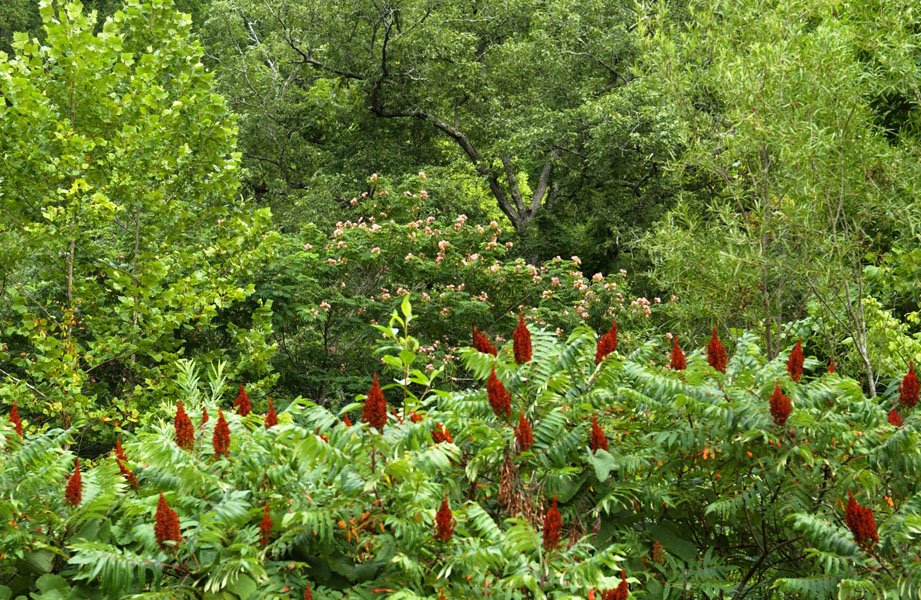
Now, in early Spetember in the Ozarks, is a great time for foraging. There are greens and potherbs such as Dandelion (Taraxacum officinale) and Lady's Thumb (Polygonum Persicaria) and a great tea maker called Sumac.
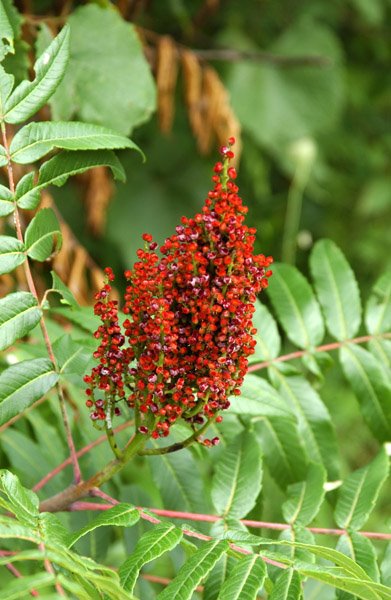
There are two kinds of Sumac around here, Staghorn (Rhus typhina) and Smooth (Rhus Glabra). Both are small trees or shrubs and this time of year have a seedhead of red berries. The earlier you harvest the berries after they turn completely red the fewer arachnids will have made their home there. Also, rain dilutes to potency so now is the time to take a walk. Sumacs are pioneer species and so will be located around field and stream edges. I usually harvest a gallon or two of berries. Notice I said berries. You will want to break off whole seed heads and allow to dry for a couple of weeks. Then simply strip the berries off and store in glass jars for future use. You can skip this step and just use the entire seed heads, right away if you like, but they will take up a lot of storage space and the twigs can make the tea bitter.
To make tea, use about 1/4 cup of berries to 1 quart of water. Bring water to a boil, add berries, remove from fire and let set about 1/2 hour. This drink is high in vitamin C and is nicknamed "Indian Lemonade" as it is VERY tart. You will want to add some stevia, honey or sugar to meet you taste. It IS good.
I haven't gone into preparing the potherbs listed above as I assume most of you know how to deal with these. If you don't, leave a comment and I'll post some instructions.
A really good book on wild edibles is, Edible Wild Plants, A North American Field Guide by Elias and Dykeman is availible from Back40Books,com by clicking here: http://www.back40books.com/search.asp?p=1&w=%7E&c=Edible+Wild&t=s