
Showing posts with label self-reliance. Show all posts
Showing posts with label self-reliance. Show all posts
Wednesday, September 26, 2007
Fend For Yourself
When did we decide campgrounds needed laundromats? When the car stalled, whose bright idea was it to reach for a cell phone instead of a tool? When did we decide to eat manufactured food instead of growing it ourselves, cooking it ourselves, and sharing it with our families and friends?
There was a time when the words "quick" and "fix" were never found together in the same sentence. When our homes needed to be built, we grabbed brothers, fathers and hammers, not a mouse that clicked on Mr. On-line Contractor. Our nation's great accomplishments were a testament to hard work, sweat and ingenuity. After all, we not only put a man on the moon, but built him a rover to drive while he was up there.
What will we achieve today? Can we turn our backs to the enemy known as convenience before it makes us helpless? Do we have what it takes to depend solely on ourselves? Can we learn the skills necessary to survive in a nation without electricity or public services such as heat, water sewage disposal, electricity and readily available gasoline? Think it can’t happen here? Look at Baghdad, the CAPITAL of Iraq, a city without reliable utilities for over four years. Think back to 9-11. Can we protect all of our water systems from deliberate contamination? Our power generating facilities from a 9-11 style attack? Our cell phone towers and transmission systems? Our country has made a lot of enemies over the past few years and those enemies are dedicated to destroying the comfortable life we Americans have become accustomed to. We can’t possibly expect to protect all of our infrastructure all of the time.
Ponder these questions, consider the consequences. Learn to be more self-reliant. Gather self-help books or instructional DVD’s. Consider acquiring the tools, knives and outdoor gear that are essential, not only for the task at hand, but for bringing back something lost: our self-reliance.
Fend for Yourself!
This article was inspired by one written by Gerber Legendary Blades and featured on their web site at www.GerberGear.com. Many book, DVD’s and tools to live the self-reliant life can be found at www.Back40Books.com . This message was written by the Old Buzzard on September 26, 2007. Permission to reproduce is granted if the article is printed in it’s entirety and credit is given to http://the-old-buzzards-roost.blogspot.com/
© 2007 The Old Buzzard


Thursday, September 28, 2006
If You Can't Forage It or Grow It Yourself, Buy Local
According to the U.S. Food and Drug Administration (FDA), the most important thing consumers can do to respond to the current E. coli outbreak in the United States is to avoid eating spinach, the suspected source of the contamination. But Dr. David Acheson, chief medical officer with the FDA’s Center for Food Safety and Applied Nutrition, acknowledges that buying spinach that is locally-grown may be a safe alternative. “Clearly the risk is significantly reduced if you know the farmer and know his farm,” he told the New York Times on Wednesday. This is particularly true if you live on the East Coast, far from the California farm that packaged the spinach that has now sickened people in at least 23 states, he added.
Worldwatch Senior Reseacher Brian Halweil, a long-time advocate of buying local food for health, security, and environmental reasons, supports this perspective. “Food that spends large amounts of time in transit, changes hands multiple times, and is processed in huge batches provides nearly unlimited opportunities for both accidental and malicious contamination,” Halweil says. He notes that smaller, local processing plants, though not immune to errors, accidents, and sabotage, at least limit the effects of these problems simply by the scale of their operations.
Halweil says that local food production and consumption could have mitigated the devastation wrought by serious outbreaks of food-borne illness in the past. In his 2004 book Eat Here, he describes how the British foot-and-mouth epidemic of 2001 spread much farther and faster than a similar 1967 outbreak because of increased long-distance transportation. While in 1967, most slaughter and consumption took place locally, by 2001 animals were being shipped from all over the United Kingdom to a central slaughterhouse. According to Halweil, as long as today’s industrial-scale food system continues to dominate global agriculture, widespread illnesses like the recent E. coli outbreak are likely to continue. “Large-scale food contamination events like this give us one more incentive to preserve farms and food makers around the nation,” he says.
This story was produced by Eye on Earth, a joint project of the Worldwatch Institute and the blue moon fund. View the complete archive of Eye on Earth stories, or contact Staff Writer Alana Herro at aherro [AT] worldwatch [DOT] org with your questions, comments, and story ideas.
Saturday, September 09, 2006
Early Autumn Eats
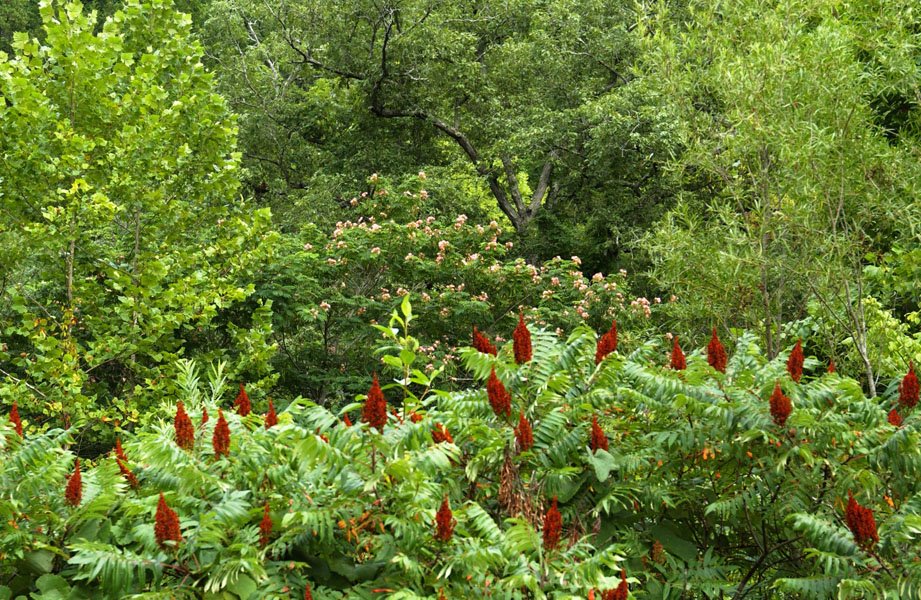
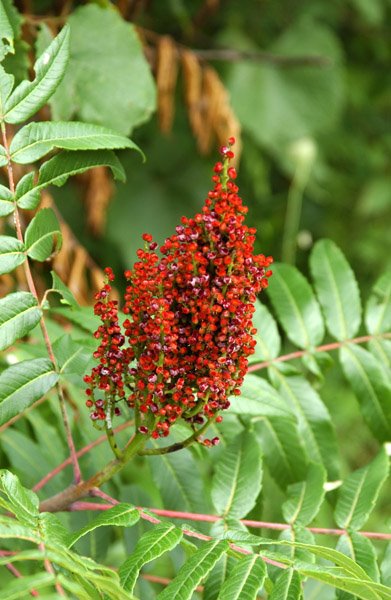
Now, in early Spetember in the Ozarks, is a great time for foraging. There are greens and potherbs such as Dandelion (Taraxacum officinale) and Lady's Thumb (Polygonum Persicaria) and a great tea maker called Sumac.
There are two kinds of Sumac around here, Staghorn (Rhus typhina) and Smooth (Rhus Glabra). Both are small trees or shrubs and this time of year have a seedhead of red berries. The earlier you harvest the berries after they turn completely red the fewer arachnids will have made their home there. Also, rain dilutes to potency so now is the time to take a walk. Sumacs are pioneer species and so will be located around field and stream edges. I usually harvest a gallon or two of berries. Notice I said berries. You will want to break off whole seed heads and allow to dry for a couple of weeks. Then simply strip the berries off and store in glass jars for future use. You can skip this step and just use the entire seed heads, right away if you like, but they will take up a lot of storage space and the twigs can make the tea bitter.
To make tea, use about 1/4 cup of berries to 1 quart of water. Bring water to a boil, add berries, remove from fire and let set about 1/2 hour. This drink is high in vitamin C and is nicknamed "Indian Lemonade" as it is VERY tart. You will want to add some stevia, honey or sugar to meet you taste. It IS good.
I haven't gone into preparing the potherbs listed above as I assume most of you know how to deal with these. If you don't, leave a comment and I'll post some instructions.
A really good book on wild edibles is, Edible Wild Plants, A North American Field Guide by Elias and Dykeman is availible from Back40Books,com by clicking here: http://www.back40books.com/search.asp?p=1&w=%7E&c=Edible+Wild&t=s
Subscribe to:
Posts (Atom)