Sunday, August 05, 2007

The Gentle Art of Blessing


by Pierre Pradervand

On awakening, bless this day, for it is already full of unseen good which your blessings will call forth; for to bless is to acknowledge the unlimited good that is embedded in the very texture of the universe and awaiting each and all.

On passing people in the street, on the bus, in places of work and play, bless them. The peace of your blessing will accompany them on their way and the aura of its gentle fragrance will be a light to their path.

On meeting and talking to people, bless them in their health, their work, their joy, their relationships to God, themselves, and others. Bless them in their abundance, their finances...bless them in every conceivable way, for such blessings not only sow seeds of healing but one day will spring forth as flowers of joy in the waste places of your own life.

As you walk, bless the area in which you live, its government and teachers, its nurses and street sweepers, its children and bankers, its priests and prostitutes. The minute anyone expresses the least aggression or unkindness to you, respond with a blessing: bless them totally, sincerely, joyfully, for such blessings are a shield which protects them from the ignorance of their misdeed, and deflects the arrow that was aimed at you..

To bless means to wish, unconditionally, total, unrestricted good for others and events from the deepest wellspring in the innermost chamber of your heart: it means to hallow, to hold in reverence, to behold with utter awe that which is always a gift from the Creator. He who is hallowed by your blessing is set aside, consecrated, holy, whole. To bless is yet to invoke divine care upon, to think or speak gratefully for, to confer happiness upon - although we ourselves are never the bestower, but simply the joyfull witnesses of Life's abundance.

To bless all without discrimination of any sort is the ultimate form of giving, because those you bless will never know from whence came the sudden ray of sun that burst through the clouds of their skies, and you will rarely be a witness to the sunlight in their lives.

When something goes completely askew in your day, some unexpected event knocks down your plans and you too also, burst into blessing: for life is teaching you a lesson, and the very event you believe to be unwanted, you yourself called forth, so as to learn the lesson you might balk against were you not to bless it. Trials are blessings in disguise, and hosts of angels follow in their path.

To bless is to acknowledge the omnipresent, universal beauty hidden to material eyes; it is to activate that law of attraction which, from the furthest reaches of the universe, will bring into your life exactly what you need to experience and enjoy.

When you pass a prison, mentally bless its inmates in their innocence and freedom, their gentleness, pure essence and unconditional forgiveness; for one can only be prisoner of one's self-image, and a free man can walk unshackled in the courtyard of a jail, just as citizens of countries where freedom reigns can be prisoners when fear lurks in their thoughts.

When you pass a hospital, bless its patients in their present wholeness, for even in their suffering, this wholeness awaits in them to be discovered. When your eyes behold a man in tears, or seemingly broken by life, bless him in his vitality and joy: for the material senses present but the inverted image of the ultimate splendor and perfection which only the inner eye beholds.

It is impossible to bless and to judge at the same time. So hold constantly as a deep, hallowed, intoned thought that desire to bless, for truly then shall you become a peacemaker, and one day you shall, everywhere, behold the very face of God.

And of course, above all, don't forget to bless the utterly beautiful person YOU are!

Saturday, June 09, 2007

The Echo of Life

A man and his son were walking in the forest. Suddenly, the son
trips and feeling a sharp pain he screams, "Ahhhhhh!" Surprised,
he hears a voice coming from the mountain, "Ahhhhh!" Filled with
curiosity, he screams, "Who are you?" but the only answer he
receives is, "Who are you?" This makes him angry, so he screams,
"You are a coward!" and the voice answers, "You are a coward!"

He looks at his father, asking, "Dad, what is going on?"

"Son," the man replies, "pay attention!" Then he screams,
"I admire you!" The voice answers, "I admire you!"
The father shouts, "You are wonderful!" and the voice answers,
"You are wonderful!"

The boy is surprised, but still can't understand what is going on.

The father explains, "People call this an 'echo' but truly
it is 'life!' Life always gives you back what you give out.
Life is a mirror of your actions. If you want more love, give
more love. If you want more kindness, give more kindness. If
you want understanding and respect, give understanding and respect.
If you want people to be patient and respectful to you, give
patience and respect. This rule of nature applies to every
aspect of our lives."

Life always give you back what you give out. Your life is not
a coincidence, but a mirror of your own doings.

-Author unknown

Monday, May 28, 2007

Asnishinaabe Hunter-Gatherer Traditional Foods


Eating the foods Creator gave us will Honor Him and give us good health.

FOCUS on LOCAL
Eating the foods that are grown in the soil and climate that you live in is very important. These STAPLE foods provide the specific nutrients your body needs. The Creator has given us everything we need literally within walking distance from where you live (wild rice, fish, deer, corn, various greens, and the other traditional foods mentioned above.) How else could people have survived without modern transportation? ... and they did so for thousands of years.

Spring Time is a time of renewal. Fish, eggs, fresh shoots (such as horsetail and cattail sprouts) and tender greens (such as lambs quarters which is also known as wild spinach, dandelion, plantain, purslane, mint, wintergreen, nettles, wood ferns, and creeping snowberry leaves) help us to cleanse our systems from the heavy winter foods.

You can view the entire Pyramid here: Anishinaabe Food Pyramid

Special thanks are in order for the Anishinaabe Center, Detroit Lakes, MN www.anishinaabe.org 218-846-9463 for commissioning this work.
The Old Buzzard

Friday, May 18, 2007

Through Food We Are All Connected

While I am not Jewish I respect the fact that every one of us has to find his or her own way to God (The Great Spirit; the One who is known by so many names and in so many ways) This article is reprinted from My Jewish Learning: http://www.myjewishlearning.com/index.htm

Eco-Kashrut: Environmental Standards for What and How We Eat
We need to renew the unity of earth and humanity.
By Rabbi Arthur Waskow

In recent decades, Rabbi Zalman Schachter-Shalomi and others have advocated a broadening of the concept of kashrut to include restrictions on consumption based on ecological considerations. Here, one of the Jewish Renewal movement's most articulate spokespersons argues the case for eco-kashrut in the form of a commentary to the Torah portion Shemini (Leviticus 9:1-11:47).This article is reprinted with the permission of the Jerusalem Report.

It reads, to modern eyes, like a cookbook. The Torah portion of Shemini begins by telling us to bring beef, mutton, and pancakes to the sacred altar at the transcendent moment of its dedication. It ends by making sure that on any ordinary day we do not eat whales, hawks, camels, or shrimp. For even in our ordinary lives, some foods are sacred.

And between these two celebrations of the sacredness of food, we witness the deaths of those who brought "strange fire" to the Holy One.

How did biblical Jews get in touch with God? By eating and choosing what to eat. Not by murmuring prayer; when Hannah did that (I Samuel 1:13), the priest Eli though she was drunk.

Why by eating? Because in the deepest origins of Jewish life, the most sacred relationship was the relationship with the earth. For shepherds, farmers, orchard-keepers, food was the nexus between adamah, the earth, and its closest relative, adam, the human. So ancient Jews got in touch with God by bringing food to the Temple. With our bodies we affirmed, "This food comes from a Unity of which we also are a part: from earth, rain, sun, seed, and our own work. It came from the Unity of Life; so we give back some of it to that great Unity."

In our most mundane moments, we affirmed through the rules of kashrut that what and how we ate was holy. And in our wildest poetic fantasies of the history of humankind, we thought that what went wrong was somehow wrongly eating--a mistake that brought upon us an earth that would bring forth only thorns and thistles for us to eat, as we toiled with the sweat pouring down our noses.

When the moment came for us to turn history around, we learned to rest. We learned Shabbat. Not from the thunderclap of Sinai, but from eating--from the manna--that sweet and flowing breast-milk of El Shaddai, the God of Breasts, All-Nourishing. From the manna, we learned that together with the earth, we rest. And rest was then extended from the seventh day to the seventh year, when the earth was entitled to rest and the human community that worked the earth was obligated to rest as well.

Today, most of us have shrugged away the bringing-near of sacred food, the sacred choice of foods we do not eat, the sacred pausing so that one-seventh of the time we do not grow our foods. We think that resting is a waste of time that could be used to make, invent, produce, do.

Indeed, in the last few hundred years, the human race has invented the most brilliant act of work in all of its history. We have affected the planet--its very biology and chemistry--in ways no species ever has before. And we have invented the Holocaust, the H-bomb, global warming. Strange fires, all of them. Fires through which a few people can now kill billions, a few corporations can now kill thousands of species.

What can we learn by renewing the ancient text? For shepherds and farmers, food was what they ate from the earth. For us, it is also coal, oil, electric power, paper, plastics, that we take from the earth. For shepherds and farmers, kashrut was the way of guiding their eating toward holiness. For us, eco-kashrut should do the same.

We should ask: Is it eco-kosher to eat vegetables and fruit that have been grown by drenching the soil with insecticides? Is it eco-kosher to drink Shabbat Kiddush wine from non-biodegradable plastic cups? Is it eco-kosher to use 100 percent unrecycled office paper and newsprint in our homes, our synagogues, our community newspapers? Might it be eco-kosher to insist on 10 percent recycled paper this year, 30 percent in two years, and 80 percent in five years?

Is it eco-kosher to destroy great forests, to ignore insulating our homes, synagogues, and nursing homes, to become addicted to automobiles so that we drunkenly pour carbon dioxide into the atmosphere, there to accelerate the heating of our globe? Strange fire indeed!

We can light a blaze to consume the earth. Or we can make a holy altar of our lives, to light up the spark of God in every human and in every species.

Rabbi Arthur Waskow is a Pathfinder of ALEPH: Alliance for Jewish Renewal, director of the Shalom Center, author of God-Wrestling--Round 2, and Down-to-Earth Judaism, and co-editor of Trees, Earth, and Torah: A Tu B'Shvat Anthology.


Sunday, February 04, 2007

The Long, Winding, Red Road

The Red Road is a circle of people
standing hand in hand,
people in this world, people between
people in the Spirit world.
star people, animal people, stone people,
river people, tree people…
The Sacred Hoop.

To walk the Red Road
is to know sacrifice, suffering.
It is to understand humility.
It is the ability to stand naked before God
in all things for your wrong doings,
for your lack of strength,
for your discompassionate way,
for your arrogance - because to walk
the Red Road, you always know
you can do better. And you know,
when you do good things,
it is through the Creator, and you are grateful.

To walk the Red Road
is to know you stand on equal ground
with all living things. It is to know that
because you were born human,
it gives you superiority over nothing.
It is to know that every creation carries a Spirit,
and the river knows more than you do,
the mountains know more than you do,
the stone people know more than you do,
the trees know more than you do,
the wind is wiser than you are,
and animal people carry wisdom.
You can learn from every one of them,
because they have something you don’t:

They are void of evil thoughts.

They wish vengeance on no one, they seek Justice.

To Walk the Red Road,
you have God given rights,
you have the right to pray,
you have the right to dance,
you have the right to think,
you have the right to protect,
you have the right to know Mother,
you have the right to dream,
you have the right to vision,
you have the right to teach,
you have the right to learn,
you have a right to grieve,
you have a right to happiness,
you have the right to fix the wrongs,
you have the right to truth,
you have a right to the Spirit World.

To Walk the Red Road
is to know your Ancestors,
to call to them for assistance…
It is to know that there is good medicine,
and there is bad medicine…
It is to know that Evil exists,
but is cowardly as it is often in disguise.
It is to know there are evil spirits
who are in constant watch
for a way to gain strength for themselves
at the expense of you.

To Walk the Red Road,
you have less fear of being wrong,
because you know that life is a journey,
a continuous circle, a sacred hoop.
Mistakes will be made,
and mistakes can be corrected -
if you will be humble,
for if you cannot be humble,
you will never know
when you have made a mistake.

If you walk the Red Road,
you know that every sorrow
leads to a better understanding,
every horror cannot be explained,
but can offer growth.

To Walk the Red Road
is to look for beauty in all things.

To Walk the Red Road
is to know you will one day
cross to the Spirit World,
and you will not be afraid…

"By Unknown"


Saturday, January 06, 2007

Way of the Sacred Pipe


If you are interested in learning the true Spiritual way of being a personal pipe carrier reading "The Way of the Sacred Pipe" by Jim Tree is where to start. "Jim Tree has taken a subject many feel is taboo, and approached it with knowledge, dignity, and great sensitivity. A must read for First Nation Peoples who have been raised away from their roots."Will O.,(Cherokee), Ciolo, Texas. "The book, "The Way of the Sacred Pipe" written by Jim Tree, is a must read for those interested in our tribal ways, especially concerning the use of stone pipes." Bud Johnston, (Anishinaabe) President, Keepers of the Sacred Tradition of Pipemakers. "In this instructive volume, Jim Tree takes us on a voyage through part of Native America and it's traditions that outsiders know little or nothing about. A good read." Slim Randles, author, "Sun Dog Days," "Ravens Prey", "Ol' Max Evans. "The Way of the Sacred Pipe" could not have come at a better time. With so many of the Indigenous ways and traditions vanishing like the morning dew, Jim Tree shares meaningful- and personal- insights into walking with the Sacred Pipe of our ancestors, not just for Indigenous Peoples, but for anyone anywhere who feels called to walk this path. With a focus on the living relationship with the Pipe instead of dogma, Jim hits the nail on the head and brings an oft-misunderstood topic into clear focus." Tim "Shadow Viper" Ott(Cherokee), Vienna, Austria. "What a breath of fresh air among all the plastic and Hollywood Stereotypes to see the real thing: Honest and authentic teachings put forth in a respectable format. Thanks to Jim Tree for this gift to the seven generations." Elisabeth Dietz, Eagle Woman, (Anishinaabe), author, "Now is the Hour-Native Prophecies for the coming Earth Changes." Author Jim Tree's training in the care of the Sacred Pipe has over the years been with several Elders representing Nations other than his own Cherokee People. This has given him a broad perspective on the ways of the Pipe, and it is from this collection of information that he offers the material presented here. His Elders of influence have been Adam Fortunate Eagle, Anishinaabe Spiritual leader, M. Running Deer, Apache spiritual leader, the late Lilly Windrider Nevarez, member of the Cherokee Medicine Society, and the late Larry War Eagle, Cherokee spiritual leader. To Order: http://www.back40books.com/get_item_978-0977-782000.htm

Monday, December 18, 2006

Prayer Ties


PRAYER TIES AND FLAGS; See Drawing. Prayer ties and flags are spiritual tools created to be a physical representation and carrier of the energy of a prayer. They may be brought and left at the spot that a ceremony is being held or carried to some other place and left as a token of your dedication. Each time the tie or flag is re-encountered it becomes a reminder of your prayer/intention and thus fortifies it with your additional energy of attention. Through your intention the prayer moves on.

I am suggesting designs for your ties or flags, but be aware that there are many forms and you may envision and design ones of your own. This is your Soul’s way of letting you know what serves it and your energy best. I suggest you try each of these examples and be on "the look out" for others that come to you. I recently read about a little "prayer basket" filled with feathers, a stone and a shell laying on a bed of herbs. Tobacco ties were tied to the handle of the basket. Please bring your ties and/or flags to place on our sacred cedar tree. If you wish, bring your supplies and make the ties here; we will have some sacred tobacco & cornmeal to use. If you can’t do this, please come anyway.

PRAYER FLAGS: Cut strips of natural cloth (so they bio-degrade) about an inch wide and in various lengths. Use various colors that please you. (Many Earth People used red, white, yellow and black representing the directions and the inter-relatedness of all things.)

PRAYER OR TOBACCO TIES: (drawing) Cut a 1 1/2 - 2 1/2" square piece of natural cloth. The color can be any color you choose that represents the dedication (prayer) you are making. Tie bundles strung together often have four colors representing the unity of the four directions.

• After you have cut the square a pinch of tobacco only or a mixture of tobacco, sweet grass, sage and/or other herbs are placed in the center of the cloth as you say your prayer (request). Your prayer is thus mentally placed with the "tobacco" into the bundle. Gather the comers together and tie it at the top around the pinch of tobacco. When tied, touch the pinch bundle to your forehead and say words of dedication that represent the quality of your thoughts in relation to the bundle. Then place the bundle in front of your mouth and nose and breath your essence into it with your out breath. Next, touch it to your throat and speak about the qualities of your speech that you make with this bundle. Touch the bundle to the center of your chest with words about your heart-felt-ness, and lastly touch your belly between your navel and your regenerative organs and speak about the qualities of creation and the powers that go with it.

You may string many ties (bundles) together on one string or cord if you wish, or make individual ones. They can be strung into a necklace to be worn during a ceremony and burned so that the smoke released carries prayers to the universe and the Great Mystery. If you tie the bundles to a sacred tree or other relation you may wish to tie downy feathers with them so that when the wind blows it carries your prayer above.

Winter Solstice Ceremony at Nature's Pace Sanctuary


December 21st is the shortest day of the year and the Sun reaches the furthest point in its southern travel at 6:22 PM that evening. In consideration of this event we will hold our annual Solstice Ceremony on FRIDAY December 22.

The festivities will begin at 2pm as we gather wood and construct our bonfire. We will also make prayer ties (See instructions for making Prayer Ties in the next post) and grind some Sacred Cornmeal for everyone to take home. Folks are welcome to come anytime from 2 pm until 6 pm. Partners and children are welcome. At 6:00 there will be a short talk explaining the ceremony and Solstice traditions.

The bonfire will be lit at 6:30 pm and will be followed by a potluck feast after the fire. Please bring some food to share. Herm and Linda will be providing Esau’s Potage, a traditional soup made of goat meat, lentils and other fresh vegetables.

We will observe the beginning of Earth Renewal by lighting a symbolic fire. Several of us will have fasted, meditated or reviewed our lives during the time leading up to this ceremony. Now we are prepared to make an offering to our ceremonial fire that will represent something about ourselves we would like to change, a habit we would like to break or we may add something symbolic to the fire that symbolizes closure in an area of our life.
Each of us will have an opportunity to step forward to the fire as we feel moved, one person at a time. We should solemnly remind ourselves of our intentions and make our fire offering. You may silently add your offering or you may share what your offering symbolizes with the group. When you are satisfied that you are in tune with your thoughts and the fire, you may step back to the group and another will step forward. There will be silence by the group during the ceremony.
When we have each made our offering representing change in our lives we will each step forward and add a final offering as we send a prayer of thanksgiving for all of our Blessings to Wakan Tanka, The Great Spirit (God). Once again, take as much time as you need, then step back and rejoin the group.

This will conclude our fire ceremony. We will now light our Owl candle to transport a portion of our fire back to the lodge where feasting and celebrating await.

We hope you can join us. RSVP is required. E-Mail your intentions to Linda at: "LindaNaturesPace (at) earthlink.net" prior to December 21 at 9pm.

Saturday, November 25, 2006

LIFE: Your Best Spiritual Guru

Many of us long to find a spiritual teacher or guru. We may feel unsure of how to practice our spirituality without one, or we may long for someone who has attained a higher level of insight to lead the way for us. Some of us have been looking for years to no avail and feel frustrated and even lost. The good news is that the greatest teacher you could ever want is always with you-that is your life.

The people and situations we encounter every day have much to teach us when we are open to receiving their wisdom. Often we don't recognize our teachers because they may not look or act like our idea of a guru, yet they may embody great wisdom. In addition, some people teach us by showing us what we don't want to do. All the situations in our lives, from the insignificant to the major, conspire to teach us exactly what we need to be learning at any given time. Patience, compassion, perseverance, honesty, letting go-all these are covered in the classroom of the teacher that is your life.

We can help ourselves to remember this perfect teacher each day with a few simple words. Each morning we might find a moment to say, "I acknowledge and honor the teacher that is my life. May I be wise enough to recognize the teachers and lessons that I encounter today, and may I be open to receiving their wisdom." We might also take some time each day to consider what our lives are trying to teach us at this time. A difficult phase in your relationship with your child may be teaching you to let go. The homeless person you see every day may be showing you the boundaries of your compassion and generosity. A spate of lost items may be asking you to be more present to physical reality. Trust your intuition on the nature of the lesson at hand, work at your own pace, and ask as many questions as you want. Your life has all the answers.
DailyOM Novermber 25, 2006

Thursday, November 16, 2006

Climb the Mountain


Climb the mountain and hear its wisdom upon the wind.
Spirits peace will flow into you as sunshine flows into trees.
The winds will blow their own freshness into you
Storms will give their energy, Moon her light, Wolf his wisdom.
Your cares and worries will drop off like autumn leaves.


Strive to make yourself like water, both gentle and strong. Make yourself gentle enough to follow the natural paths of the world And yet strong enough to rise up and reshape the world around you.

In your journey you search for answers and wisdom
Yet the best things in life are already nearest to you.
Spirits breath in your nostrils, sunlight in your eyes, flowers at your feet,
The duties at your hand, and the path of rightness laying just before you.

Do not grasp at the stars; take life's plain, common work as it comes,
Bid your children to accept and walk with Nature.
Let them see the beautiful blending and communions of death and life
Teach them of the joyous inseparable unity.
To learn in woods and meadows, plains, mountains, and streams
Discovering the blessed path we walk.

And help them to learn that death is not the end perceived,
But as beautiful as life and as unending as creation.
Spirit provides the three things we crave most:
Happiness, freedom, and peace of mind,
Easily attained by simply giving them to someone else.

The Old Buzzard offers his thanks to author
Steve ‘Easy' Whitacre who posted this on
A Single Standing Teepee
Nov. 16th, 2006

Monday, November 13, 2006

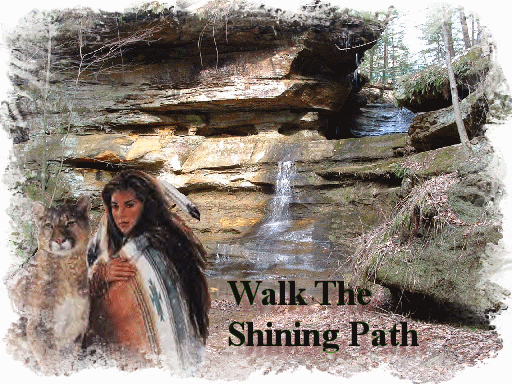
Walk the Shining Path


We all desire a better tomorrow. A World made better, more peaceful and tranquil, with which to raise our children and live our lives. If you want to make a real difference in this world we all share, there are steps to learn to take. First, learn to be optimistic. Don’t allow yourself to be depressed, frustrated and disillusioned, all the time. Know that you are doing what you can and that it counts. Every single solitary thing that we each do and say and, most especially think, really does count. More than you can ever believe. Some might argue that we don't have any choice in this upside down dangerous world and that we can't effect what will happen. But even if we can't immediately alter the course of human events on the world level, we can certainly create change in our own lives and in all of the lives that we touch, (and this is really where it all starts, yourself), and our thoughts are the seeds of that change.

Use your thoughts wisely. Understand their power. Thoughts have a tendency to become their physical equivalent. This is one of the fundamental laws of the universe. Another one is the Law of Attraction, which states that 'like attracts like,' positive to positive, negative to negative. Because it is consciousness that creates reality, the kind of consciousness you hold, your vibration if you will, actually creates the kind of life you're living. So our first order of business must be to stay positive. Hold and entertain only positive possibilities. Teach yourself to imagine only affirmative alternatives. Surround yourself with wholly uplifting, life-affirming people and influences. Align yourself solely with the greater good so that your actions will be born of only the finest of your best intentions.

Remind yourself that far away, there in the sunshine, are your highest aspirations. You may not reach them, but you can look up and see their beauty, believe in them, and try to follow where they lead. I have been haunted recently by the words written by a Protestant minister after the downfall of the Nazi regime. "First they came for the gays. I am not gay, so I didn’t say anything. Then they came for the Gypsies. I am not a Gypsy, so I didn’t say anything. Then they came for the Jews. I am not a Jew, so I didn’t say anything. Then they came for the Catholics. I am not a Catholic, so I didn’t say anything. When they finally came for me, there was no one left to say anything."

Be bold. Make a statement. Make a stand. Make a difference.
In light of the widespread oppression, manipulation, intimidation that surrounds us today, you most certainly need to say something. You need, in fact, to talk to everyone who you meet, actually engage on a human level with those who you encounter as you make it through our day. Not just your families, friends and colleagues or those of presumed like-minds, but the shoe repair guy, the waitress at the coffee shop, the post office clerk, the bag boy at the super market.

If you ignore, exploit or patronize those people whose lives intersect with yours, how can you expect international relations to be more civilized? You need to "Walk your talk" wherever you go, whatever you do, remembering always, that by doing so you do make a difference. Let yourself be a sun, sending your caring energy out into the world, shedding light wherever you go. You never know who you might touch, or what a difference you may make with the radiance of your smile and warmth of your friendship.

Walk in peace and beauty,

Steve (Easy) Whitacre, Copyright 2006


Friday, October 13, 2006

Kewaa's Baskets


Growing up a woman was not an easy task for the women of Kewaa's village. The burdens of every day were hard on a woman's spirit and body. Kewaa saw this through her young eyes.

One day, as she helped her mother scrape a hide in preparation to make clothes from it, she dared to ask, ''Why do we work so hard and when we are sad and so tired, we have to keep all these woes to ourselves?''

Kewaa's mother stopped and, taken by surprise by her daughter's question, very softly asked, ''Why do you ask such questions? Complaining will not get anything done and no one wants to hear our problems. You should not let anyone hear you talk like that, especially the men.''

''But the men have their games and sit around and talk. They can complain,'' Kewaa was quick to answer.

''I know, my daughter,'' her mother replied. ''You are right. There are days when it is very hard for me to do my tasks. There are times when I think about your grandmother, my mother and how I miss her so. My sadness keeps me from doing my work. Where did all these questions come from my daughter? You are always so quiet. You are young. You should not worry so over such things.''

Kewaa became quiet for a while, but she felt she had to answer her mother and explain her feelings. She told her mother she also had days of sadness and days when she was so tired that she found it hard to work. She was no different because she was younger. Illness, sadness and just being troubled do not happen only to older people, but to everyone.

Her mother sighed and said, ''You think too much.''

Kewaaa became very quiet and went on with all her tasks of the day.

Later on, as the sun was starting to leave to make room for the moon, she took a walk to the river. It was her favorite place to go. She would watch the fish peek at her from the river; listen to the trees sing their song in the breeze and just try her best to feel good about her day. But that evening was different. She was sad and she could not help herself. Tears rolled down her face as she leaned over to look into the world of the river. Crying seemed the only way to get rid of her burdens.

As she wiped her eyes, she noticed the reflection in the water. The reflection was not her own, but a beautiful woman with long white hair. Startled but not scared, she asked the woman in the water, ''Who are you?''

''It matters not who I am,'' the reflection answered. ''But I know who you are and I am used to a smiling face. I have never seen you sad. Why do you cry?''

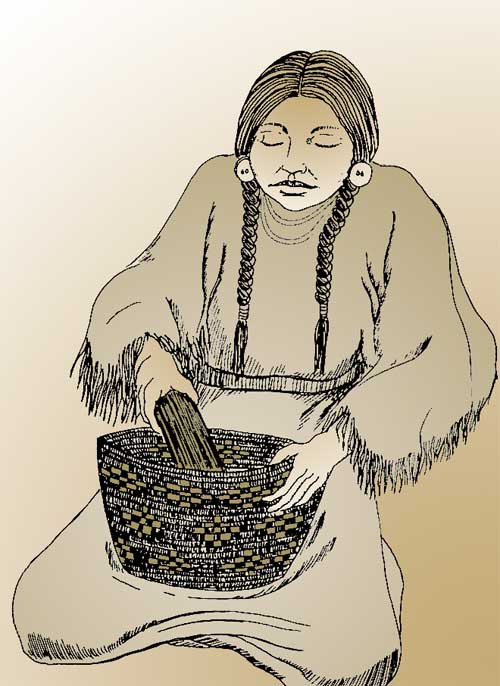
Kewaa told all her complaints and woes to the kind face in the water and it made her feel good. ''I am sorry to tell you of all my burdens, but what could I do?'' The woman smiled and said, ''You need to find a way to put these burdens to rest in a special place. Make baskets from the reeds and grasses. Have the other women help you. Then make sure every home has a basket in it placed by the entrance.

''Your homes are a sacred place. You do not want to fill them with worries, illness and anger. Explain to all that they should put their worries in the basket before they enter their homes. Also put their anger there. Send all these burdens and bad feelings away. Let the baskets help you to reach within yourselves for inner strength and wisdom and to solve problems. Let them be the keepers of all your private thoughts. Also tell the people the baskets will make their burdens lighter because, as they give the baskets their burdens, they will become less and so disappear.''

Kewaa promised she would do as the woman told her, but asked, ''Who should I tell the people told me this?''

''Tell them the Creator, for he makes the river and I speak for him. Kewaa, please tell your people not to enter another's home with bad feelings or woes, but to put them in their basket. It would not be good to leave one's troubles in another's home. You go now. You have a lot to do. The next time you visit me I hope to see you smiling.''

''You will!'' Kewaa replied. ''Thank you.''

Off she ran to her home to tell her mother. By the time Kewaa got home, it was past her time for bed and her mother was concerned that something had happened to her.

But after Kewaa told her of her day and what she experienced her mother was very happy. They planned to gather everyone together in the beginning of the new day. After all, there were baskets to be made. As the day was new, Kewaa was sure to be up extra early. She could not wait to spread the word for all to come to her home so she could tell them what she learned. As the people showed up, Kewaa's mother stood proud as her daughter spoke of the burden baskets. Everyone listened and even then the men helped in gathering reeds and different grasses, for they too needed places to put their burdens.

For the next two days, everyone was busy making baskets; and as they wove the baskets all had a chance to talk and share stories, which made everyone feel good. Laughter ended the night. They finished the last basket. After that night, all had their baskets and all did as Kewaa had said. It helped each one find the strength they needed and make their burdens lighter. Kewaa never saw the woman in the river again, but some say she was looking at herself as an elder.

I, myself, am not gifted in the craft of basketmaking, but you can be sure I have a basket at my door and try to lay my burdens in it every time I come home.


Copyright by Ken ''Rainbow Cougar'' Edwards, from the Colville Indian Reservation in Washington, is an accomplished painter and storyteller. Edwards is a graduate of the Institute of American Indian Arts in Santa Fe, N.M., and a longtime cartoonist for Indian Country Today. Originaly posted on ONEOFMANYFEATHERS@groups.msn.com

Thursday, September 28, 2006

If You Can't Forage It or Grow It Yourself, Buy Local

According to the U.S. Food and Drug Administration (FDA), the most important thing consumers can do to respond to the current E. coli outbreak in the United States is to avoid eating spinach, the suspected source of the contamination. But Dr. David Acheson, chief medical officer with the FDA’s Center for Food Safety and Applied Nutrition, acknowledges that buying spinach that is locally-grown may be a safe alternative. “Clearly the risk is significantly reduced if you know the farmer and know his farm,” he told the New York Times on Wednesday. This is particularly true if you live on the East Coast, far from the California farm that packaged the spinach that has now sickened people in at least 23 states, he added.

Worldwatch Senior Reseacher Brian Halweil, a long-time advocate of buying local food for health, security, and environmental reasons, supports this perspective. “Food that spends large amounts of time in transit, changes hands multiple times, and is processed in huge batches provides nearly unlimited opportunities for both accidental and malicious contamination,” Halweil says. He notes that smaller, local processing plants, though not immune to errors, accidents, and sabotage, at least limit the effects of these problems simply by the scale of their operations.

Halweil says that local food production and consumption could have mitigated the devastation wrought by serious outbreaks of food-borne illness in the past. In his 2004 book Eat Here, he describes how the British foot-and-mouth epidemic of 2001 spread much farther and faster than a similar 1967 outbreak because of increased long-distance transportation. While in 1967, most slaughter and consumption took place locally, by 2001 animals were being shipped from all over the United Kingdom to a central slaughterhouse. According to Halweil, as long as today’s industrial-scale food system continues to dominate global agriculture, widespread illnesses like the recent E. coli outbreak are likely to continue. “Large-scale food contamination events like this give us one more incentive to preserve farms and food makers around the nation,” he says.

This story was produced by Eye on Earth, a joint project of the Worldwatch Institute and the blue moon fund. View the complete archive of Eye on Earth stories, or contact Staff Writer Alana Herro at aherro [AT] worldwatch [DOT] org with your questions, comments, and story ideas.

Thursday, September 14, 2006

The Red Road

Long road winding began in the stars,
spilled onto the mountain tops,
was carried in the snow to the streams,
to the rivers, to the ocean…
It covers Canada, Alaska, America,
Mexico to Guatamala,
and keeps winding around the indigenous.

The Red Road is a circle of people
standing hand in hand,
people in this world, people between
people in the Spirit world.
star people, animal people, stone people,
river people, tree people…
The Sacred Hoop.

To walk the Red Road
is to know sacrifice, suffering.
It is to understand humility.
It is the abilility to stand naked before God
in all things for your wrong doings,
for your lack of strength,
for your discompasionate way,
for your arrogance - because to walk
the Red Road, you always know
you can do better. And you know,
when you do good things,
it is through the Creator, and you are grateful.

To walk the Red Road
is to know you stand on equal ground
with all living things. It is to know that
because you were born human,
it gives you superiority over nothing.
It is to know that every creation carries a Spirit,
and the river knows more than you do,
the mountains know more than you do,
the stone people know more than you do,
the trees know more than you do,
the wind is wiser than you are,
and animal people carry wisdom.
You can learn from every one of them,
because they have something you don’t:

They are void of evil thoughts.

They wish vengence on no one, they seek Justice.

To Walk the Red Road,
you have God given rights,
you have the right to pray,
you have the right to dance,
you have the right to think,
you have the right to protect,
you have the right to know Mother,
you have the right to dream,
you have the right to vision,
you have the right to teach,
you have the right to learn,
you have a right to grieve,
you have a right to happiness,
you have the right to fix the wrongs,
you have the right to truth,
you have a right to the Spirit World.

To Walk the Red Road
is to know your Ancestors,
to call to them for assistance…
It is to know that there is good medicine,
and there is bad medicine…
It is to know that Evil exists,
but is cowardly as it is often in disquise.
It is to know there are evil spirits
who are in constant watch
for a way to gain strength for themselves
at the expense of you.

To Walk the Red Road,
you have less fear of being wrong,
because you know that life is a journey,
a continuous circle, a sacred hoop.
Mistakes will be made,
and mistakes can be corrected -
if you will be humble,
for if you cannot be humble,
you will never know
when you have made a mistake.


If you walk the Red Road,
you know that every sorrow
leads to a better understanding,
every horror cannot be explained,
but can offer growth.

To Walk the Red Road
is to look for beauty in all things.

To Walk the Red Road
is to know you will one day
cross to the Spirit World,
and you will not be afraid…

"Unknown" This work is NOT copyrighted. Feel free to copy and distribute.
The Old Buzzard's Roost


Wednesday, September 13, 2006

Eat, Exercise, and Be Healthy: A Lesson from Our Ancestors


Long before fast-food restaurants became a part of our lives, our ancestors hunted wild animals for meat, gardened, and gathered berries, nuts and plants to provide a healthy and well-rounded diet.

These "hunter-gatherers", as they were called lived long before the beginning of agriculture and the domestication of animals. Many groups throughout the world continue to live this way today. Perhaps most interesting for today's health conscious people, these humans did not and do not have anywhere near the amount of the so called "diseases of civilization" such as cancer, stroke, diabetes, and high blood pressure that cause 75% of all deaths in America today.

It is commonly thought that the reason our ancestors did not get these diseases is because they did not live long enough. It is true that these early people often died early in their life because of infections or accidents. But those who survived these early set-backs lived long lives--surpassing in length the longevity of people today.

So why didn't they get "age-related" diseases like heart disease and high blood pressure? Scientists believe that diet and exercise had a lot to do with it.
You may wonder how we can know how people lived long ago and what they ate. First, the bones of these early people have been found and analyzed by scientists. Bones reveal how much calcium a person consumed in his or her diet, for instance, or how strong this person was. Also, there are people who still live today as hunter-gatherers throughout the world. Though they are mistakenly referred to as "primitive" people, they actually have very sophisticated knowledge about plants, animals and vitamins and minerals in their environment. Modern scientists are now trying to learn as much as they can about the medicinal use of plants from the medicine men and women of these tribes.

It is known that today's hunter-gatherer tribes live very much the way that our early ancestors lived. Researchers are studying these people to determine what contributes to their health.
In the past men and women got much more exercise than the average person today. Basically, they needed to engage in relatively heavy and consistent physical activity just in order to eat. The men in these early and present tribes were and are hunters. Hunting requires walking or jogging long distances for hours or days to track animals. And the women were no slouches either. It appears that the primary responsibility of women in early tribes was to garden and gather plant foods, berries, nuts and fruits.

In one African tribe existing today, the women routinely walk between two and twelve miles per day to gather food three days per week. If you think a twelve mile walk is impressive you be even more impressed when you consider the 15 - 35 pounds of food they carry on the return trip. In addition, many are also carrying babies on their backs. And, gathering food does not mean lazily picking up fruit off the ground: these women often have to climb the trees to get the fruit. Or, they dig out potato-like tubers or roots buried in the ground.

Today we are told to eat foods from four basic food groups: meat and fish, vegetables and fruits, milk and milk products, and breads and cereals. Our ancestors derived most of their nutrients from two groups: meat and fish, and vegetables and fruits. Even today, most hunter-gatherer groups do not rely on milk or milk products or upon breads or cereals. These products were not available to anyone until the beginning of agriculture. These two food groups supplied our ancestors with a good healthy diet. Much healthier than our diet of cereals, white flour and processed foods. If you compare modern diet with those of our ancestors, present day people are the losers.

Our ancestors consumed far more calcium (for good strong bones) and fiber (prevents colon cancer) than we do today. Our ancestors ate a high-protein, high fiber diet. Their intake of sodium, which causes high blood pressure in some people, was far lower than the intake of the average American today. When they consumed fat they consumed polyunsaturated animal fats instead of the hydrogenated plant fats that are included in today's processed foods.

Interestingly, their cholesterol intake was higher than modern peoples because they consumed much more meat than most folks in "civilized" societies now. However, our ancestors, and today's hunter-gatherers, ate wild game which has a much lower fat content than animals raised in confinement today. Furthermore, these fats were of the polyunsaturated type, the opposite of what is contained in our confinement raised beef, pork and poultry.

Additionally, unlike their cooped up counterparts today, wild animals ate a natural diet that did not contain hormones, tranquilizers and antibiotics. These wild animals had as much as 20% less fat than domesticated, confinement raised animals on commercial "factory" farms. These early people also did not have to contend with refined flour and grains which have had the fiber removed, so their food had more bulk and roughage than present day processed products.

Modern peoples wishing to live longer, healthier lives can take lessons from our ancestors: Eat whole un-refined grains, free-range or wild meats, and plenty of high-fiber vegetables. Limit your intake of carbohydrates and eat a high protein diet based on lean meats. Avoid sugars.

You can learn more about the benefits of native-style and high protein - high fiber diets from the following books, most of which are available from www.Back40 Books.com web store or by calling 1.866.596.9982.


Recommended Reading:

Traditional Foods are Your Best Medicine, Ronald Schmid, N.D

Buffalo Bird Woman's Garden, Gilbert Wilson

Nutrition and Degeneration, Weston A. Price

Dr. Atkins Diet Revolution, Robert C. Atkins, M.D.

Saturday, September 09, 2006

Early Autumn Eats


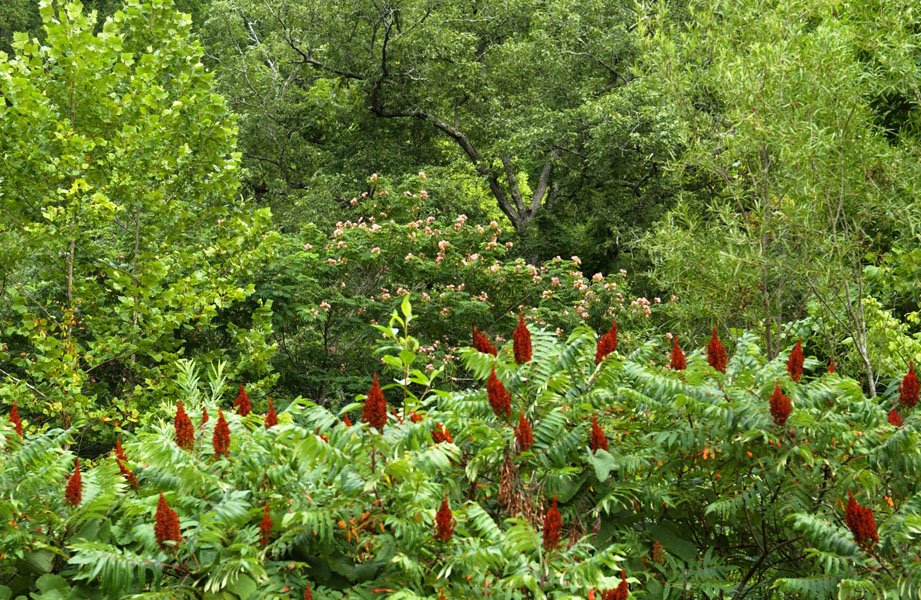
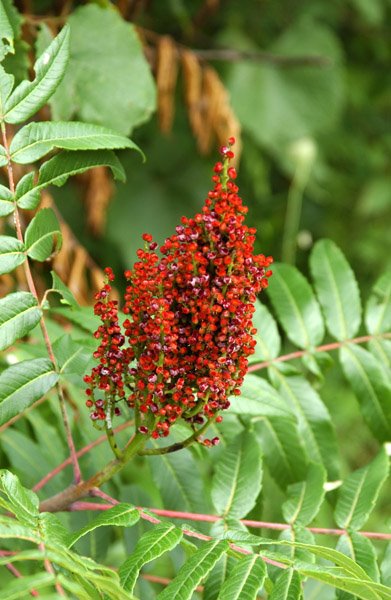
Now, in early Spetember in the Ozarks, is a great time for foraging. There are greens and potherbs such as Dandelion (Taraxacum officinale) and Lady's Thumb (Polygonum Persicaria) and a great tea maker called Sumac.
There are two kinds of Sumac around here, Staghorn (Rhus typhina) and Smooth (Rhus Glabra). Both are small trees or shrubs and this time of year have a seedhead of red berries. The earlier you harvest the berries after they turn completely red the fewer arachnids will have made their home there. Also, rain dilutes to potency so now is the time to take a walk. Sumacs are pioneer species and so will be located around field and stream edges. I usually harvest a gallon or two of berries. Notice I said berries. You will want to break off whole seed heads and allow to dry for a couple of weeks. Then simply strip the berries off and store in glass jars for future use. You can skip this step and just use the entire seed heads, right away if you like, but they will take up a lot of storage space and the twigs can make the tea bitter.
To make tea, use about 1/4 cup of berries to 1 quart of water. Bring water to a boil, add berries, remove from fire and let set about 1/2 hour. This drink is high in vitamin C and is nicknamed "Indian Lemonade" as it is VERY tart. You will want to add some stevia, honey or sugar to meet you taste. It IS good.
I haven't gone into preparing the potherbs listed above as I assume most of you know how to deal with these. If you don't, leave a comment and I'll post some instructions.
A really good book on wild edibles is, Edible Wild Plants, A North American Field Guide by Elias and Dykeman is availible from Back40Books,com by clicking here: http://www.back40books.com/search.asp?p=1&w=%7E&c=Edible+Wild&t=s

Friday, September 08, 2006

Welcome!

This blog is about my rustic life. I strive to live in Harmony with all of Creation, and I try to make posts that will be evocative and will lead others to this way of life. I live and work in a very remote area of the Missouri Ozark mountains surrounded by hundreds of thousands of acres of wilderness land. I actually live a dual lifestyle: Many days I am at one of my computers heavily involved in the "virtual world" creating how-to videos, taking nature photographs and helping out with our web bookstore www.Back40Books.com Other days I will be out in the "Real World" practicing my "Old Ways" lifestyle and Spirituality.
My posts will often detail activities that are appropriate to the changing seasons such as foraging, hunting, gardening, wood cutting and tracking. I will present specific details and use photographs as necessary. If you would like to see photographs I have for sale visit my photography web gallery at www.Chenoweth-Collection.com
As I strive to live the life the creator has directed me to do I will also talk about aboriginal spirituality and antique Indian Ways of Living in Harmony with Nature. Feel free to make follow up posts or ask questions at any time. Thanks for Dropping by!
The Old Buzzard